


CleanGreen Comfort System

What makes a great heating and cooling system? How do I get crisp clean air? Why are my utility bills higher than my neighbors? Why is there so much dust? These are questions that we often hear from homeowners in the metro Atlanta area. We have developed our CleanGreen Comfort System as a practical guide to the minimum standards and components required for a more efficient HVAC system. CleanGreen Comfort Systems promise to deliver the comfort you need with the level of efficiency that will lower your bills and help the planet.
What difference does a CleanGreen Comfort System make?
Your existing furnace and air conditioner may seem to be working well enough, but your utility bills are high and odors linger for days. Evaluating your heating and cooling system is the beginning of taking necessary steps to bring your system up to the CleanGreen Comfort System standards. It’s not as expensive as you might think to improve your home’s cooling and heating efficiency-the energy savings alone will eventually offset the your investment. We think that you deserve to be comfortable. A CleanGreen Comfort System is designed to ensure a safer, cleaner, and more comfortable home or work environment.
Here’s How Empire Provides You With a CleanGreen Comfort System for Your Home.
New equipment must meet a specific set of efficiency standards to qualify as a Clean Green Comfort System®. All new Clean Green Comfort® systems include the very popular variable speed blower motor that provides quiet, low-cost operation in addition to special features for system operation. Existing systems in good working order can be retrofitted with the other components of a Clean Green Comfort System® and qualify as well.
- Cooling System: A minimum efficiency of 14 SEER (Seasonal Energy Efficiency Rating) has been mandated by the Department of Energy. The future minimum efficiency mandates are uncertain with many proposals pushing the minimum to 15 or even 16 SEER. CleanGreen Comfort System standards require a minimum 16 SEER as this modest upgrade will meet current Energy Star requirements, ensure you meet future mandates and provide continuous savings over the life of your new system.
- Heating System: The CleanGreen Comfort System standard for heating systems is 80% AFUE (Annual Fuel Utilization Efficiency) for gas heating equipment and a minimum 8.5 HSPF for electric heat pump systems as long as a variable speed blower and two stage operation are incorporated in the unit.
- Variable Speed Blowers: Variable speed blowers offer extreme advantages. In the cooling modes having enhanced blower operation greatly improves the moisture removal capabilities of the cooling system. In the heating mode variable speed allows for proper distribution at first stage heating. In the ventilation mode the ultra-low speed operation is critical to maximize the benefits of air treatment, ventilation and air filtration systems.
Filters are critical to the proper performance of a heating and cooling system as well as your first line of defense to provide clean air to breathe. The CleanGreen Comfort System minimum standard is a 4″ extended surface MERV 9 filter. (Minimum efficiency reporting value is a measurement scale designed by the American Society of Heating, Refrigerating and Air-Conditioning Engineers (ASHRAE) to rate the effectiveness of air filters.) Filters are one of many factors that have an effect on air quality in heating and cooling systems.
The ductwork, registers, grilles, plenums, and dampers that carry the air from and to your home makes up the distribution system. Distribution systems require sealing to “Duct and Envelope Tightness” (DET) standards. They must be properly sized using National Comfort Institute (NCI) standards for proper airflow.
Studies have shown duct leakage can reduce a systems efficiency by as much as 50% and is a major contributor to indoor air quality issues. Field testing demonstrates that many systems have inadequate ducting resulting in poor balance of temperature in a conditioned space. It also produces excessive Total External Static Pressure, which reduces the efficiency and longevity of equipment. Proper sizing, sealing, insulation, and installation of ducting is required to ensure total optimal system performance.
A CleanGreen Comfort System requires a minimum of one germicidal ultraviolet light installed at the evaporator coil to help keep the coil clean. Evaporator coils are enclosed in a dark and damp environment throughout the cooling season. Germicidal Ultraviolet light is an acceptable method to maintain the coil and inhibit biological growth. Studies have shown the use of germicidal ultraviolet light has promising results in reducing airborne viruses and bacteria providing a safer and healthier indoor level of air quality.
Humidity control is not a minimum requirement of a CleanGreen Comfort System. The need to add humidity for heating or reduce humidity for cooling is application specific and can vary greatly with factors external to the comfort system. Operational analysis is required to determine if additional equipment is required to maintain proper humidity levels.
A CleanGreen Comfort System requires a minimum of outside air as required per ASHRAE (American Society of Heating Refrigeration and Air Conditioning Engineers) Standard 62.2 in order to maintain acceptable indoor air quality levels. The required minimum ventilation rate is the simplified calculation from 62.2 or 5% of system airflow. In cases where outside air ducting is not possible or where outside air is undesirable for ventilation the requirement of adding a Photocatalytic Oxidation (PCO) device to the germicidal light will be an accepted alternative.
Indoor air can be two to five times more contaminated than outside air according to the US Environmental Protection Agency (EPA/600/6-87/002a). External conditions (lifestyle, structure, ambient conditions) can create swings in humidity and air quality. In order to control the quality of indoor air for improved living and working environments, the use of these additional components are required to deliver fresh clean indoor air.
In order to verify systems are working to full capacity performance testing to document total system performance is a requirement. Many contractors will verify a system performance by simply determining the difference in temperature between supply air and return air. In order to determine actual delivered efficiency and capacity of a heating and cooling system total airflow and enthalpy (moisture content change of the air) must be considered in a known well sealed duct system. National Comfort Institute (NCI) has developed a program of HeatMaxx and CoolMaxx testing that is part of a CleanGreen Comfort System program.
System maintenance on a bi-annual basis is required to maintain a CleanGreen Comfort System. Approximately Seventy nine million (79,000,000) cubic feet of air move through an average cooling system each year and another one hundred eighteen million (118,000,000) each winter during the heating season. The only way to keep a system performing properly and at capacity is to have a routine maintenance program to keep filters clean and system settings verified. Routine inspections will also help reduce the amount of service and repairs required in high demand seasons.
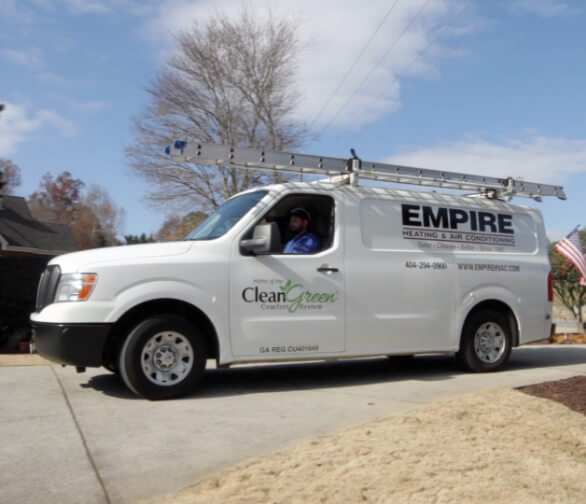
As a full-service HVAC contractor, you can rely on us for these other quality products.
- Air conditioning systems
- Heating systems
- Ductless systems
- Heat pumps
- Thermostats & zoning systems
- Indoor air quality
Want to Learn More about CleanGreen Comfort Systems? Contact Empire Today!
At Empire, we look forward to the opportunity to meet with you and discuss the benefits of a CleanGreen Comfort System. Call us at 404-294-0900 or contact us online today to learn more!