



Why You Need to Change Your AC Filter and How Often
Replacing your air conditioner filter on a regular schedule is the easiest, most cost-effective way to protect your HVAC equipment and maintain healthy indoor air.
How often you should change your AC filter depends primarily on the thickness and material of the filter, as well as specific conditions in your home like pets, allergies, and local pollen levels:
| Filter Type & Household Situation |
Typical Replacement Frequency |
Key Consideration |
|---|---|---|
| Standard 1″ Fiberglass Filter | Every 30 days | Inexpensive, but fills quickly and offers minimal particle trapping. |
| Pleated 1″ to 2″ Filter (MERV 8–11) | Every 60 to 90 days | The ideal balance of filtration efficiency and steady airflow for most homes. |
| Pleated 4″ to 5″ Media Filter | Every 6 to 12 months | Deep-pleat filters designed for high-efficiency cabinets with high dust capacity. |
| Homes with Pets | Every 30 to 45 days | Pet dander and shedding fur clog surface area much faster than normal. |
| Homes with Allergy/Asthma Sufferers | Every 30 to 45 days | Frequent changes prevent captured micro-particles from restricting airflow. |
| Georgia Spring Pollen Season | Check monthly | Metro Atlanta’s intense spring pollen can blind a fresh filter in weeks. |
| Vacant or Low-Occupancy Homes | Every 6 months | Lower dust accumulation, though filters still collect baseline ambient debris. |
When Is the Best Time to Replace Your AC Filter?
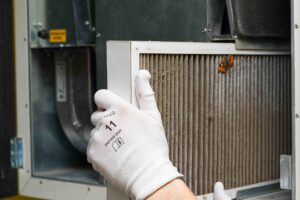 The general guideline of changing an air filter “every three months” works as a baseline, but it doesn’t account for how different households operate. The right schedule for your home depends on the physical build of the filter and the volume of airborne debris moving through your system.
If you use basic 1-inch fiberglass filters, plan to replace them monthly. They are designed to catch large debris only and fill up rapidly. Standard 1-inch to 2-inch pleated filters offer better filtration and typically last 60 to 90 days under normal conditions. High-capacity 4-inch to 5-inch media filters installed in dedicated cabinets hold vastly more dust and generally only require service once or twice a year.
Lifestyle factors override these standard timelines. Pets shed hair and dander continuously, which coats the filter material and restricts air passage much faster than static dust. Similarly, during Metro Atlanta’s spring season, high pollen counts force your system to pull heavy volumes of airborne particles through the return grates. In these situations, inspecting your filter every 30 days ensures you catch buildup before it strains your system.
Signs Your Filter Needs Changing Now
You do not need to wait for a specific date on the calendar to swap out a clogged filter. Your HVAC system will show clear physical signs when airflow is restricted:
- Reduced airflow from supply vents: The volume of air coming out of your registers feels weak or low.
- Visible dust and debris buildup: Dust settles quickly on hard surfaces, baseboards, and return grates shortly after cleaning.
- Unusually high energy bills: The blower motor runs longer and consumes more electricity to force air through a restricted screen.
- Musty or stale odors: Accumulated organic matter trapped in the filter creates a lingering dirt smell when the system turns on.
- Visible dirt on the filter media: The surface of the filter appears dark gray, matted with dust, or visibly bowing from pressure.
Why are your HVAC filters so important?
Indoor Air Quality & Filters
Your HVAC filter serves as the first line of defense against recirculating airborne contaminants. Every time your system runs, it pulls room air through the return ducts, trapping dust, dirt, carpet fibers, and pollen within the filter medium. When the filter remains clean, it actively removes these pollutants from circulation. Once a filter reaches full capacity, it can no longer capture new particles, leaving dust to settle throughout your living areas and reducing overall air hygiene.
Filters and the Functional HVAC
The primary engineering purpose of an air filter is not actually to purify the room air, but to protect the internal components of your air conditioner from debris buildup. For your system to cool efficiently, indoor air must pass freely across the evaporator coil. A clean filter allows correct static pressure and volume to move across these coils. When a filter becomes restricted, the air blower must work harder to draw air through, increasing mechanical strain and electrical consumption.
Longevity and Your Filters
Consistently operating an air conditioner with a dirty filter causes premature wear across critical moving parts. Blower motors heat up when forced to pull against high resistance, leading to electrical breakdown over time. Furthermore, restricted airflow alters operating pressures inside the system, putting unnecessary stress on the compressor. Simply replacing your filter on schedule eliminates one of the leading causes of avoidable mechanical breakdowns, helping your equipment reach its full expected operational lifespan.
Selecting the Right MERV Rating for Your Home
When buying filters, you will see a MERV (Minimum Efficiency Reporting Value) rating ranging from 1 to 16 for residential systems. This rating measures how effectively the filter traps particles of specific sizes:
- MERV 1 to 4: Basic fiberglass filters. They protect equipment from large lint and dust, but do little for indoor air quality.
- MERV 8 to 11: Superior pleated residential filters. They efficiently capture dust mites, pet dander, mold spores, and fine dust without restricting system performance.
- MERV 13 to 16: High-efficiency filters. They trap microscopic particles, smog, and bacteria, but create higher resistance to airflow.
For most residential systems, choosing a filter between MERV 8 and MERV 11 provides the optimal balance between high filtration efficiency and proper system airflow.
Caution is required with higher MERV ratings. Installing a MERV 13 or higher filter into an older or standard residential HVAC system can severely restrict airflow if the ductwork and blower motor were not explicitly sized for high-resistance media. Restricting airflow too tightly creates the exact same mechanical issues as a dirty filter. If you want to explore advanced filtration options, review our guide on MERV ratings for Metro Atlanta homeowners or consult a technician to verify what your system can safely accommodate.
How a Dirty Filter Leads to Bigger AC Problems
A dirty filter is not merely an inconvenience; it is the root trigger for severe operational failures that leave your home without cooling.
When dust completely blocks a filter, the system cannot draw enough warm room air across the indoor cooling coil. Without warm air passing over it, the refrigerant inside the coil cannot absorb heat, causing its temperature to drop below freezing. Condensation on the coil turns to ice, eventually resulting in a completely frozen air conditioner.
Once the coil is encased in ice, air cannot move through it at all. The blower fan will continue to run and push air through your ducts, but with the coil iced over and airflow blocked, you will end up with your AC blowing warm air into your home. A neglected $15 filter can easily cause a total system shutdown on a hot summer afternoon.
Don’t Let This Common Metro Atlanta AC Problem Catch You Off Guard
Suffocating airflow due to dirty filters is among the most common residential AC problems in Metro Atlanta.
Our region’s long, humid cooling seasons mean local air conditioners run hundreds of hours continuously during summer months. That continuous operation accelerates dust accumulation on filter surfaces. Metro Atlanta homeowners who neglect routine filter changes often face rising energy costs, short-cycling equipment, and avoidable system failures during peak summer heat waves.
Whether Your Metro Atlanta Home Needs Maintenance or Emergency Repairs, Empire Has You Covered
If changing your filter does not restore normal airflow or proper cooling to your home, underlying mechanical issues may require professional attention.
The technicians at Empire HVAC perform comprehensive system diagnostics to identify airflow restrictions, clear frozen evaporator coils, and correct underlying component stress. Contact us today to learn about our routine preventative maintenance programs or to schedule professional AC repair services.